From Hayez's The Kiss to Mantegna's Christ Dead: a thoughtful guide to the paintings that make Brera one of Europe's finest galleries. What to look for, in which room, and why they matter.
Experiences and tickets for Pinacoteca di Brera offered by our booking partners.
Brera Pinacoteca artworks
A gallery made of masterpieces, not numbers
The strength of Pinacoteca di Brera lies not in quantity but in density. A few rooms concentrate some of the most studied paintings in Italian art history: works you've already seen in school textbooks that here you can finally observe just inches away. The collection spans seven centuries, from Gothic through to Hayez's Romanticism, passing through the heart of the Renaissance.
This guide doesn't list everything: it selects the works worth the journey and explains, before each one, what to look for so you don't just grab a quick photo. It's the best way to turn a "passing through" visit into a memory that stays with you.
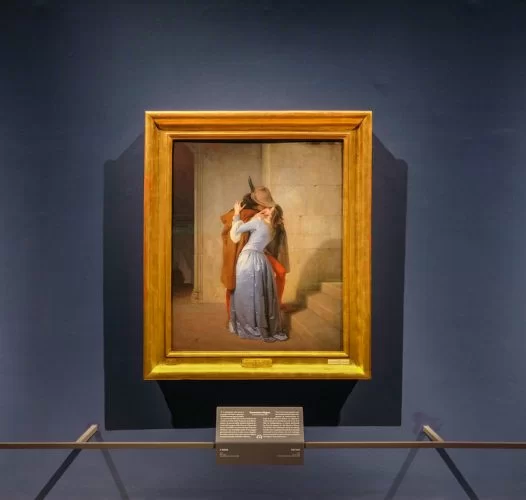
The most photographed work in the museum and one of the iconic images of nineteenth-century Italy.
Two lovers kiss on a staircase in a barely sketched medieval interior. It seems like an intimate scene and that's all, but The Kiss is also a political manifesto: the colors of the clothes reference the Risorgimento and the alliance between Italy and France. Hayez painted it in the year of imminent unity, and that private gesture became the kiss of an entire nation at its freedom.
What to observe closely: the iridescent silk of the woman's dress, rendered with almost tactile mastery, and the man's foot on the step, a sign he's ready to leave. It's a goodbye, not just a meeting. Hayez painted multiple versions: the one at Brera is the most celebrated.
Room 24 · Renaissance
Marriage of the Virgin — Raphael (1504)
A masterpiece painted at 21 years old: a perfect lesson in perspective and harmony.
Raphael signs and dates the work at the top of the temple: he was barely over twenty. The Marriage of the Virgin stages Mary and Joseph's wedding before a centrally-planned temple that steals the scene. The floor lines converge toward the temple door, drawing the eye into depth: Renaissance perspective at its pinnacle.
Observe the sweetness of the faces and the balance of the composition, divided into two mirror-image groups. Compare this work with that of his master Perugino on the same subject: you'll see how quickly the student surpassed the teacher.
Detail not to miss
The rejected suitor breaking his rod on his knee in the foreground at right: a narrative touch that animates the entire scene.
Room 6 · Fifteenth century
Christ Dead — Andrea Mantegna (1480 ca.)
The most famous foreshortening in art history.
For many it's the most impressive work at Brera. Mantegna depicts Christ Dead seen from the feet, in a dramatic foreshortening that brings the viewer right beside the body. The perspective is deliberately "corrected": if mathematically exact, the feet would cover the face. Mantegna shrinks them so as not to lose the expression on the face and the wounds.
It's a painting you don't forget. Stand in silence before the stone of unction, observe the folds of the shroud almost carved and the tears of the mourners on the left. A few square meters containing centuries of anatomical study.
Room 29 · Seventeenth century
Supper at Emmaus — Caravaggio (1606)
The drama of light taken to Baroque extremes.
Painted while fleeing Rome, the Supper at Emmaus at Brera is darker and more austere than the London version. The risen Christ reveals himself to two disciples in the gesture of blessing the bread; around them, darkness. Caravaggio uses tenebrism — extreme contrasts of light and shadow — to make the moment of revelation almost tangible.
Notice the marked faces, the rough hands, the absence of idealization: the figures are real people, poor, tired. It's this humanity that made Caravaggio the most modern painter of his time.
Room 24 · Renaissance
Brera Altarpiece — Piero della Francesca (1472-74)
Sacred conversation with the celebrated suspended egg.
Commissioned by Federico da Montefeltro, portrayed kneeling in armor, the Brera Altarpiece is a prodigy of geometry and light. Above the Madonna hangs an ostrich egg suspended by a shell: symbol of birth, perfection and, some say, the Montefeltro dynasty. The painted architecture seems the real continuation of the chapel.
Piero della Francesca was also a mathematician: here every element answers to precise proportions. It's a painting to observe with patience, letting the eye follow the lines of the apse.
Room 6 · Fifteenth century Venetian
Pietà — Giovanni Bellini (1465-70 ca.)
One of the most tender and sorrowful images of Venetian Renaissance.
Bellini's Pietà shows the Madonna supporting the dead Christ, with Saint John beside her. Nothing excessive: only restrained sorrow, delicate gestures, landscape background that gives air. Latin text runs across the parapet inviting tears — a poetic signature by the painter.
Bellini is the master who will bring color and atmosphere to Venice: here you already see his sensitivity, in the soft light that envelops the figures.
B
"If you only have thirty minutes, choose Mantegna and Hayez: they're at opposite poles — one is death and silence, the other life and passion — and they contain the entire arc of art at Brera. Everything else becomes wonderful elaboration."
— Brera Guide editorial team, room notes
Recommended itinerary: masterpieces in 90 minutes
The rooms at Brera follow chronological order. To avoid getting lost, here's a proven route that touches the highlights without backtracking:
Rooms 1-6: Gothic and Fifteenth century — here Mantegna and Bellini.
Room 24: the Renaissance heart — Raphael and Piero della Francesca, side by side.
Rooms 28-29: Seventeenth century and Caravaggio.
Final rooms (37-38): Nineteenth century and the grand finale with Hayez's The Kiss.
For the best times to walk it undisturbed, check the hours guide. If you prefer a live story, consider a guided tour.
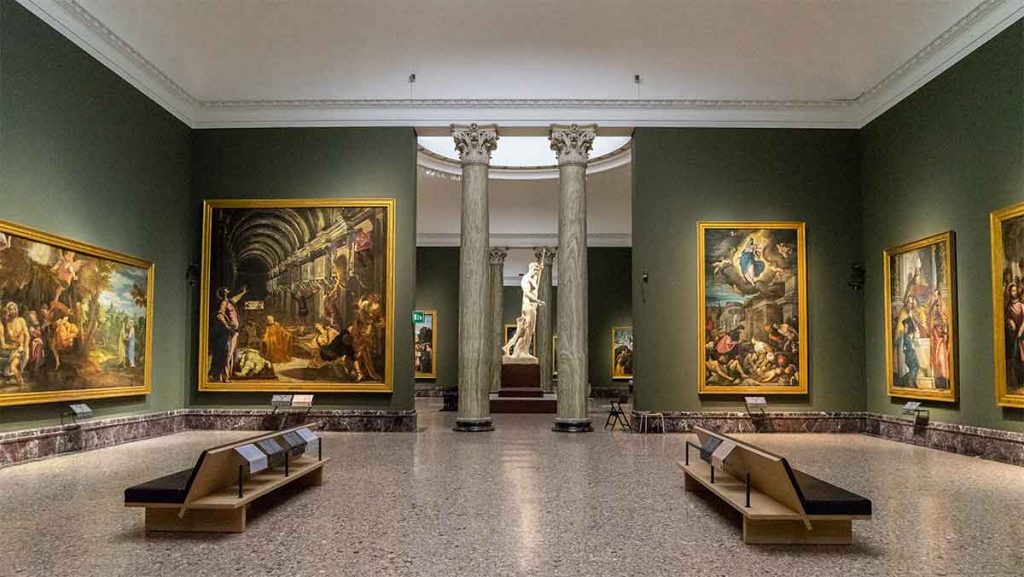
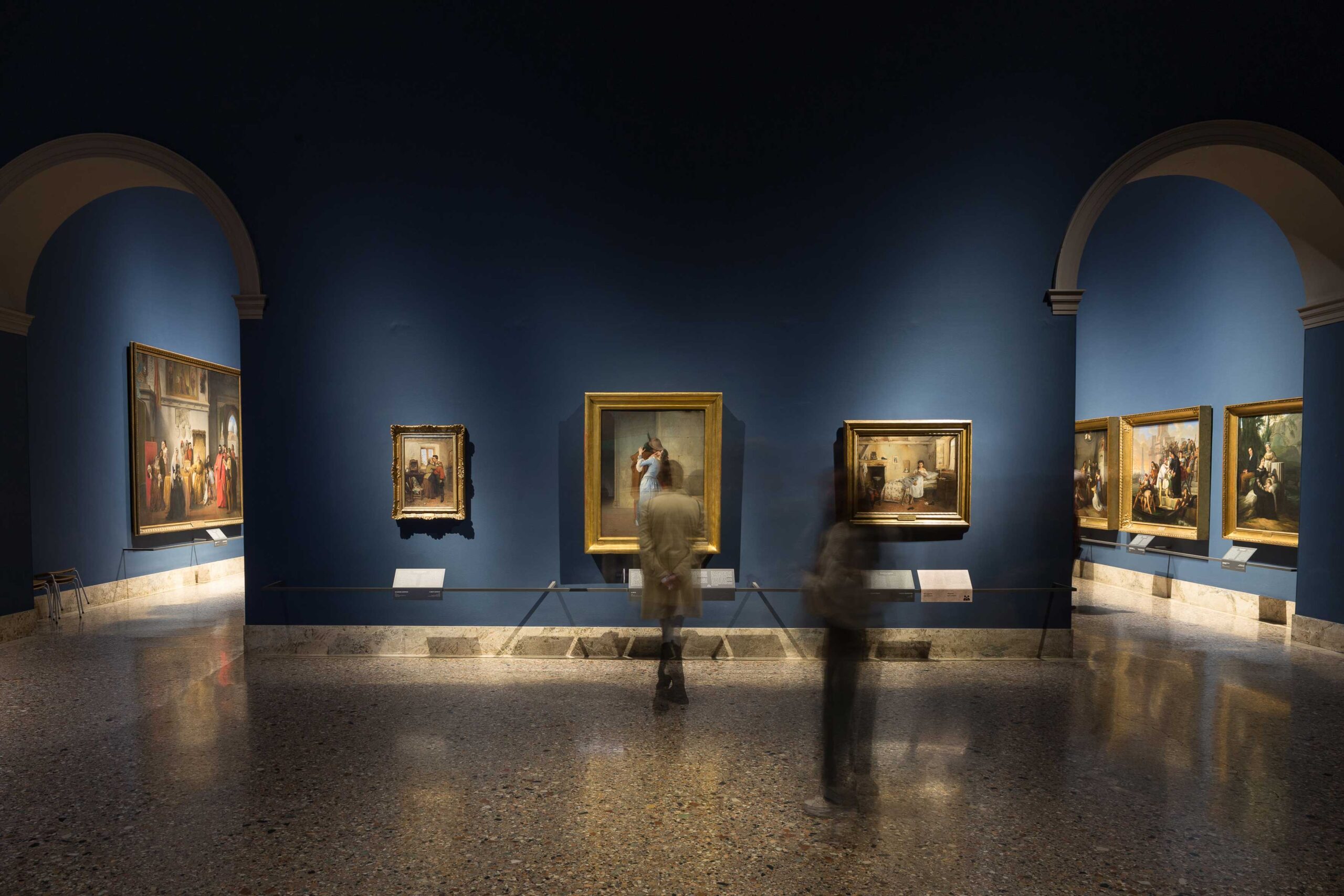
The grand rooms of Brera dialogue with the colors of the walls, chosen to enhance the artworks on display.
Practical tips for looking at artworks
Yes to photos, no to flash: photography without flash is generally permitted; respect the notices in individual rooms.
Get close (with measure): at Brera you can observe details from very near, but keep your distance from the frames.
Read the labels: they're clear and bilingual; for children, turn the visit into a "detail hunt".
Audio guide or app: the museum offers official audio content through a dedicated app; they enrich the visit greatly.
Temporary exhibitions
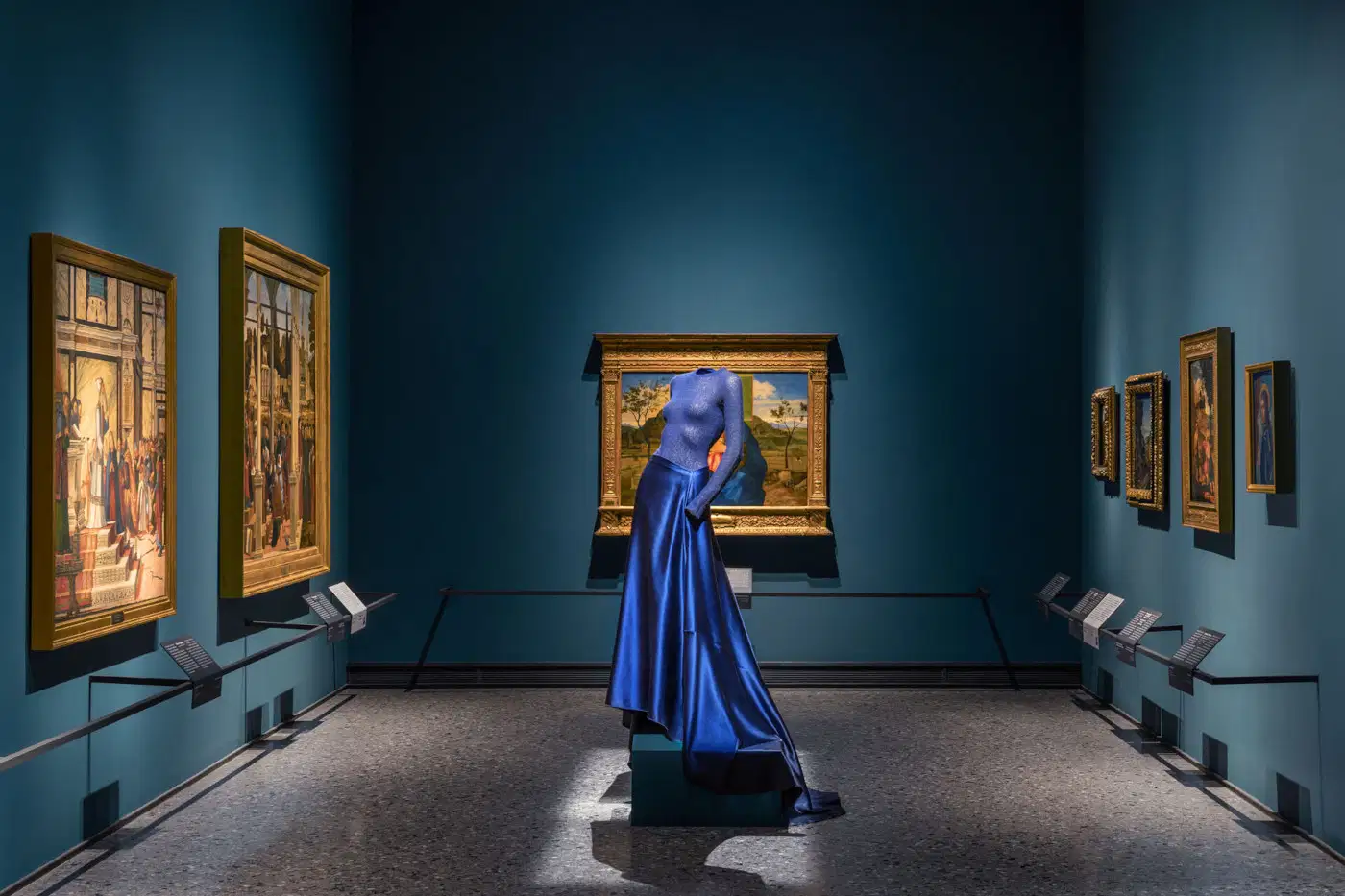
Beyond the permanent collection, Brera hosts exhibitions and dialogues between ancient and contemporary art. Check the updated schedule on the official website before your visit.
Other artworks worth a stop
Beyond the six main masterpieces, Brera houses paintings that alone would justify a visit to any other museum. If you have time, look for them:
Christ at the Column by Bramante: rare painting by the great Renaissance architect, of surprising dramatic intensity.
The Finding of the Body of Saint Mark by Tintoretto: a theatrical scene with vertiginous perspectives and magnetic light.
The Preaching of Saint Mark in Alexandria by Gentile and Giovanni Bellini: a monumental canvas rich in oriental details.
Fiumana by Pellizza da Volpedo: preparatory study linked to the celebrated Quarto Stato, manifesto of social painting.
Madonna of the Rose Garden by Lombard artists: late Gothic sweetness that opens the museum's journey.
The collection also ranges beyond Italian art: you'll find works by Flemish schools and masters like Rubens and Van Dyck, sign of a collection conceived to tell the entire European painting.
Palazzo Brera: the container is already a work of art
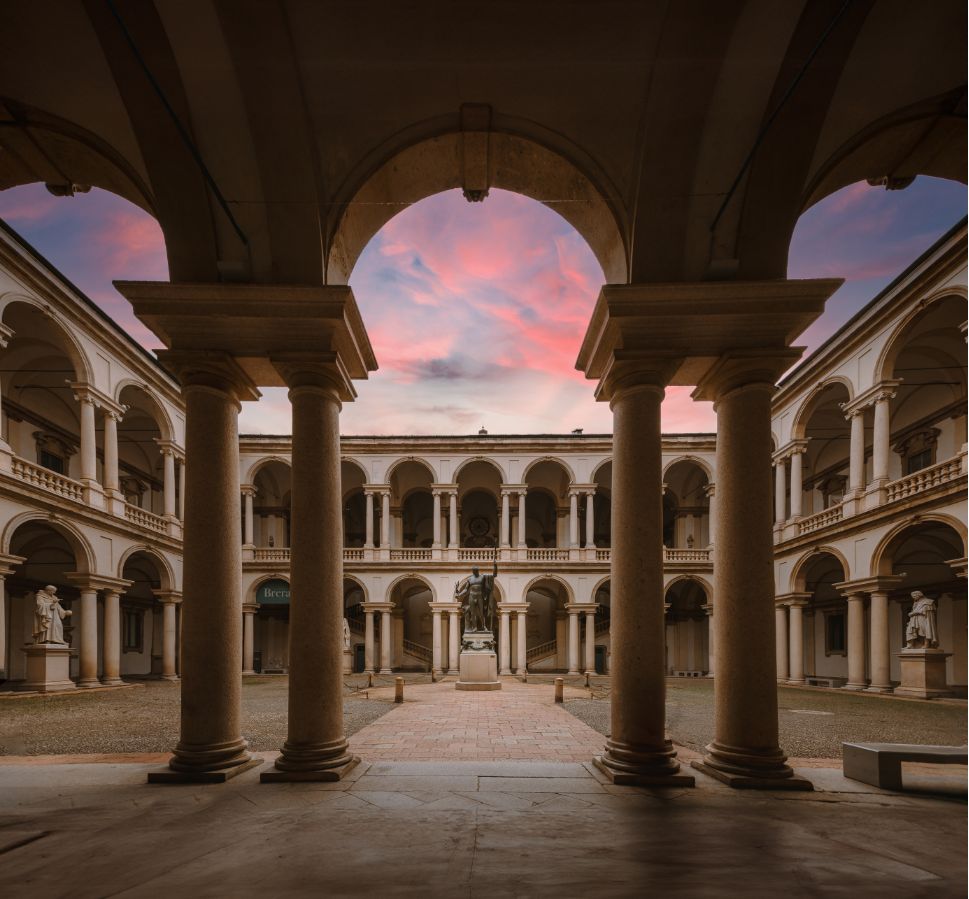
Don't forget to look up. The museum is housed in Palazzo Brera, a seventeenth-century building that also hosts the Academy of Fine Arts, the Braidense National Library and the Botanical Garden. The majestic courtyard of honor, with its double order of arcades and the bronze statue of Napoleon as Peacemaker by Antonio Canova at center, is scenery worth a stop alone — and it's freely accessible.
The gallery was born here for a reason: to give Academy students models to study from life. It's a "didactic" museum in its DNA, and this origin explains the curated quality of the collection. Also not to be missed: the restoration workshop with transparent walls, designed by Ettore Sottsass: it lets you observe restorers at work, a rare behind-the-scenes look in a major museum.
The courtyard of honor of Palazzo Brera: the colonnade and statue of Napoleon greet visitors.
How to read a painting at Brera (in 4 steps)
A small method to avoid just glancing at each work:
First the whole: observe the composition from a distance, without reading anything.
Then the details: move closer and look for particulars — a gesture, an object, an inscription.
Then the context: read the label to understand who, when and why.
Finally your gaze: step back and look at the whole again. You'll see things that escaped you before.
It works with any work, but at Brera it brings special satisfaction before Mantegna and Piero della Francesca, where every detail is calculated.
Attributions, dates and artwork locations may vary due to museum needs. Information verified on the official website pinacotecabrera.org at publication date.
See the masterpieces in person
Book your entry to Pinacoteca di Brera and admire up close the works by Hayez, Raphael, Mantegna and Caravaggio.